
Otsuka vs. Sun Pharma – Case Snapshot:
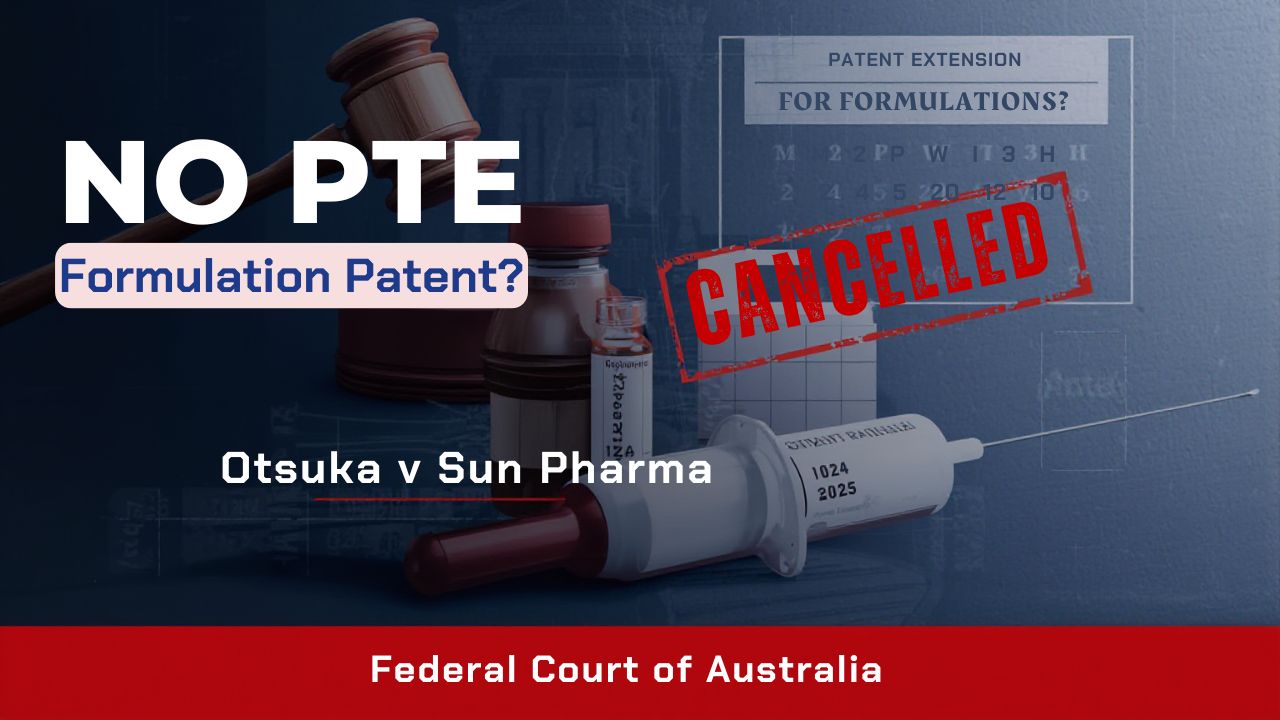
The judgment in Otsuka vs. Sun Pharma (Otsuka Pharmaceutical Co., Ltd v Sun Pharma ANZ Pty Ltd FCAFC 161) is a landmark Federal Court of Australia Full Court decision on patent validity and patent term extension (PTE) for controlled‑release aripiprazole formulations used in schizophrenia and bipolar I disorder. The Court dismissed Otsuka’s appeal and upheld the invalidity of the patent term extension, holding that the relevant formulations were not “pharmaceutical substances” for the purposes of section 70 of the Patents Act 1990 and that the patent had therefore expired in October 2024.
The case sits at the intersection of formulation technology, data‑driven claim drafting and the Australian PTE regime, and is highly instructive for pharmaceutical innovators planning lifecycle management strategies around depot or controlled‑release products.
Otsuka vs. Sun Pharma – Basic Case Details:
- Court: Federal Court of Australia, Full Court
- Citation: Otsuka Pharmaceutical Co., Ltd v Sun Pharma ANZ Pty Ltd
- Registry/Division: New South Wales Registry, General Division, Intellectual Property – Patents and associated statutes.
- Date of judgment: Dec 1, 2025.
- Appeal from: Sun Pharma ANZ Pty Ltd v Otsuka Pharmaceutical Co Ltd FCA 44.
- Parties:
- Otsuka (with H. Lundbeck A/S and Lundbeck Australia Pty Ltd and others) was the patentee and appellant group;
- Sun Pharma ANZ Pty Ltd was the respondent generic company.
The patent in issue, Australian Patent No. 2004285448 titled “Controlled release sterile injectable aripiprazole formulation and method”, related to long‑acting injectable (LAI) aripiprazole depot formulations, including products marketed as Abilify Maintena.
Otsuka vs. Sun Pharma – Background:
Aripiprazole is an antipsychotic agent whose therapeutic effect arises from binding to dopamine D2 and other receptors in the brain, and it is used in treating schizophrenia and bipolar I disorder. At the priority date, aripiprazole itself was not new; it was already the subject of a US compound patent (US5006528) and immediate‑release aripiprazole tablets had been listed on the Australian Register of Therapeutic Goods (ARTG) in 2003 in various strengths (2–30 mg).
The claimed innovation lay not in the molecule but in controlled‑release injectable formulations, including:
- an aqueous suspension depot (the “Controlled Release Injectable Formulations” exemplified by claim 1 and dependent claims), and
- freeze‑dried (lyophilised) controlled‑release aripiprazole formulations that are reconstituted with water to form an injectable suspension (the “Freeze‑dried Controlled Release Formulations” exemplified by claim 16 and dependants).
Both sets of claims required aripiprazole particles with a mean particle size of about 1–10 microns and a vehicle (with suspending agents, bulking agents, buffers and optional pH adjusters), designed to release therapeutic amounts of aripiprazole over at least one or two weeks.
The specification emphasised that particle size was “essential” to achieving a prolonged release window, stating that smaller particles shortened the release period and that adjusting mean particle size could modulate the duration of release from around two to six weeks or more. Example data in rats, dogs and humans were reported using mean plasma concentration–time profiles to illustrate sustained aripiprazole plasma levels for multiple weeks following a single depot injection.
Otsuka vs. Sun Pharma – Procedural History and Issues on Appeal:
Otsuka’s 20‑year patent term expired on Oct 18, 2024, but Otsuka had obtained a PTE to 25 July 2029 based on Abilify Maintena kits listed on the ARTG. Sun Pharma commenced proceedings to revoke the PTE and avoid infringement liability for its proposed generic depot aripiprazole product, while Otsuka cross‑claimed for threatened infringement and misleading conduct under the Australian Consumer Law.
At first instance, the primary judge held that:
- The “PTE Claims” (a subset of claims relied upon to support the PTE) were invalid for failing to define the invention and lacking clarity under sections 40(2)(b) and 40(3); and
- The PTE was invalid because the alleged pharmaceutical substances did not fall within section 70(2)(a).
On appeal, Otsuka challenged, among other things:
- Whether the key “release over at least [X] weeks” feature was a limitation by result (NoA Ground 4),
- Whether the claims lacked clarity and failed to define the invention under the pre‑Raising the Bar version of section 40 (NoA Grounds 1–3), and
- The findings that the PTE and infringement claims failed (NoA Grounds 5–8).
Sun Pharma’s Amended Notice of Contention argued, in essence, that the PTE was invalid for additional reasons, most importantly that the formulations were not “pharmaceutical substances” at all within the meaning of section 70(2)(a) and Schedule 1.
Otsuka vs. Sun Pharma – Construction of the Formulation Claims:
Limitation by Result: The Court agreed with the primary judge that the integer “which upon injection releases aripiprazole over a period of at least [one / two] weeks” operated as a limitation by result, not merely an inherent consequence of particle size and formulation choice.
Otsuka vs. Sun Pharma – Key findings included:
- The claims positively require a formulation that, upon injection, releases aripiprazole over a minimum specified period; on their face these words must be satisfied, not ignored as a non‑limiting recital.
- The formulations are broadly drafted (aripiprazole particles in a vehicle plus water, with “comprises” language) and multiple variables influence release time: particle size, dose, volume, injection site and excipient composition.
- The same particle size range (e.g. 1–10 microns) is associated in different claims with different minimum release periods, confirming that particle size alone is not determinative of the claimed release window.
As a result, a skilled formulator must adjust parameters with the target release result in mind, and the “release over at least X weeks” wording draws the boundary between infringing and non‑infringing products.
Otsuka vs. Sun Pharma – Clarity and Section 40:
The more nuanced question was whether claims limited by such a result were sufficiently clear and defining under sections 40(2)(b) and 40(3). The Full Court revisited classic authorities such as General Tire and Australian decisions on ambiguity and clarity, emphasising that:
- some experimentation is acceptable,
- the test is practical and not about hypothetical puzzles at the claim’s margins, and
- claims can legitimately be framed by reference to performance thresholds where no perfect measurement exists, provided a workable standard is available.
The Court held that Sun Pharma’s clarity test (“can the skilled person determine whether all embodiments that otherwise meet the PTE Claims fall inside or outside the boundary, even with routine experimentation?”) set the bar too high. On a proper reading of the specification, the examples and plasma profiles taught the skilled addressee to use blood plasma concentration data as a surrogate for release, even though “release” in pharmacological terms is not identical to plasma level.
Importantly, the Court accepted that:
- the patent does not need to explain the theoretical basis of each integer or prove that every formulation within the claim scope will work; and
- given the inherent difficulties of measuring in‑vivo depot release directly, the use of plasma profiles as an approximation of release duration was a reasonable and sufficiently clear approach.
The Full Court therefore concluded that the PTE Claims did define the invention and were clear and succinct, and would not be invalid under sections 40(2)(b) and 40(3) if the patent had remained in force.
Otsuka vs. Sun Pharma – The Core Holding: What Is a “Pharmaceutical Substance”?
Statutory Framework:
The pivotal issue on the Notice of Contention was the scope of “pharmaceutical substance” in section 70(2)(a) and Schedule 1 of the Patents Act. Under the PTE regime, a patentee can extend the term of a standard patent if the patent claims a “pharmaceutical substance per se” and certain regulatory and timing requirements are met.
Following detailed analysis of the legislative history (Patents Act 1903, 1952, 1990; 1989 and 1998 amendments; 2006 reforms) and prior authorities such as Boehringer, Alphapharm (Lundbeck cases), AbbVie and Cipla, the Full Court addressed whether this concept includes formulations or is limited to APIs.
Formulations Do Not Qualify:
The Full Court held that the “pharmaceutical substance” concept in section 70(2)(a) and Schedule 1 is limited to active pharmaceutical substances, and does not extend to depot or controlled‑release formulations as such.
Key aspects of the reasoning were:
- “Pharmaceutical substance per se” has been consistently interpreted as the substance “by or in itself”, as distinct from methods of use, methods of delivery or product‑by‑process claims.
- The broader statutory history and explanatory memoranda show that Parliament intended PTEs to reward the time taken to obtain regulatory approval for new active substances, not for new dosage forms or delivery technologies of existing drugs.
- The High Court’s discussion in Alphapharm HC (including the footnote stating that patents for methods and tablets do not fall within section 70(2)(a)) was treated as consistent with the idea that formulation‑based innovations sit outside the core substance‑per‑se PTE scheme.
On that basis, the Court concluded that Otsuka’s controlled‑release aripiprazole depot products while therapeutically valuable are not “pharmaceutical substances” for PTE purposes because they are formulations of an existing API rather than new substances per se.
The consequence was that Sun Pharma’s Notice of Contention succeeded and the PTE was held invalid; the patent had expired on Oct 18, 2024, rendering the infringement and ACL issues largely academic.
Otsuka vs. Sun Pharma – Why This Decision Matters for the Pharmaceutical Industry:
Sharp Line Between API and Formulation for PTE: This judgment reinforces a crucial policy line: PTEs protect new active substances, not new ways of packaging, delivering or formulating known drugs. For innovators, that has several implications:
- Long‑acting injectables, depot formulations, controlled‑release tablets, novel excipient systems and similar technologies are unlikely to qualify for PTE under section 70(2)(a) if they employ an already‑registered API.
- Lifecycle management strategies that rely on PTE must focus on compound‑level innovation or possibly on qualifying process‑based substances under section 70(2)(b), rather than solely on formulation optimisation.
- Investment and pricing models for LAIs and depot products need to reflect the more limited patent life where the core API is already known and listed on the ARTG.
For generic companies, the decision provides greater certainty that once the core substance patent has expired and any valid PTE on that substance has run out, formulation patents will not be extended via the PTE regime.
Validation of Performance‑Based Claiming (With Limits):
On the technical side, the Full Court’s acceptance that the PTE Claims met section 40 clarity and definition requirements is a significant signal for drafting performance‑or result‑based claims in pharma. The Court endorsed, in principle:
- The use of functional language such as “releases [API] over at least X weeks”, provided the specification teaches a reliable surrogate (e.g. plasma profiles) and the skilled person can work out in a practical, real‑world way whether a formulation falls inside or outside the claim.
- The idea that claims need not foreclose all possible borderline disputes or eliminate every hypothetical difficulty; clarity is assessed at a practical, not perfectionist, level.
For formulation scientists and patent drafters, this supports drafting claim sets that combine structural features (particle size, vehicle composition, concentration ranges) with in‑vivo performance parameters, so long as the disclosure and common general knowledge together supply a workable test methodology.
Otsuka vs. Sun Pharma – Strategic Lessons for Lifecycle and Data Packages:
The case also offers tactical lessons around evidence and regulatory patent alignment:
- Otsuka’s human and animal PK data were central both to supporting the performance‑based claim language and to the debate over whether the claims were limited by result.
- However, extensive internal deconvolution and modelling work was also scrutinised and, at first instance, viewed as indicating that determining release boundaries precisely would be onerous and uncertain.
- The Full Court’s correction of the clarity test suggests that robust PK and PD data remain powerful tools to anchor functional claim language, but patentees should anticipate that such data may be used to argue both sufficiency and clarity – or their absence.
For pharmaceutical companies, a key practical takeaway is that regulatory data packages and patent drafting strategies must be tightly integrated: PK/PD evidence used for ARTG approval can also serve (positively or negatively) in later attacks on clarity and validity.
Otsuka vs. Sun Pharma – Broader Impact on Australian Pharma Patent Strategy:
In combination with earlier authorities such as Lundbeck, AbbVie and Cipla, this decision continues a clear line of Australian jurisprudence that:
- Constrains PTE to the chemical or biological substance level,
- Limits the use of PTE to extend monopoly periods for follow‑on dosage forms and formulation tweaks, and
- Expects sophisticated, data‑supported claim drafting when innovators seek to protect sophisticated controlled‑release technologies.
For multinational innovators, this means Australian patent strategy cannot simply copy US or EU approaches where supplementary protection certificates or other mechanisms may have different scope; Australian PTE remains relatively narrow and API‑centric. For domestic generics, the decision confirms an environment where earlier entry of generic depot and LAI products is more feasible once core substance protection ends, subject to surviving formulation patents of standard 20‑year duration.
Overall, Otsuka v Sun Pharma ANZ is likely to be heavily cited in any future dispute where a patentee attempts to frame a formulation as a “pharmaceutical substance” for PTE purposes, and it will shape how companies plan the patent, regulatory and commercial lifecycle of controlled‑release and depot products in Australia.
Citation:
Otsuka Pharmaceutical Co Ltd v Sun Pharma ANZ Pty Ltd [2025] FCAFC 161
Disclaimer:
This blog post is for general information and educational purposes only and does not constitute legal, regulatory, medical, or other professional advice. The discussion of Otsuka v Sun Pharma, Australian patent term extensions, and pharmaceutical regulation is necessarily high‑level and may not reflect all relevant facts, legal developments, or jurisdiction‑specific requirements. Readers should seek advice from a suitably qualified professional before taking or refraining from any action based on this content, and no responsibility is accepted for any loss arising from reliance on the material provided.
Also Read This…
Seagen vs. Daiichi Sankyo: CAFC Opinion
Samsung vs. Oura Patent Dispute
The Amgen vs. Sanofi-Regeneron PCSK9 Patent Saga: UPC Decision
Exenatide Patent Application Refusal Case: The Delhi High Court Judgment
The Dutch Court Refuses SPC for Durvalumab
Interim Injunction in the Empagliflozin “Jardiance” Patent Dispute
Allergan vs. Sandoz – CAFC Strikes Down Allergan’s Latisse Patent Claim 30
UK Court of Appeal Revokes Dapagliflozin Patent: Key Lessons on Plausibility and Inventive Step