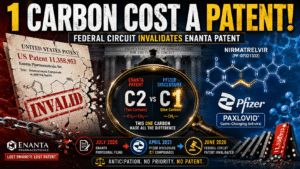

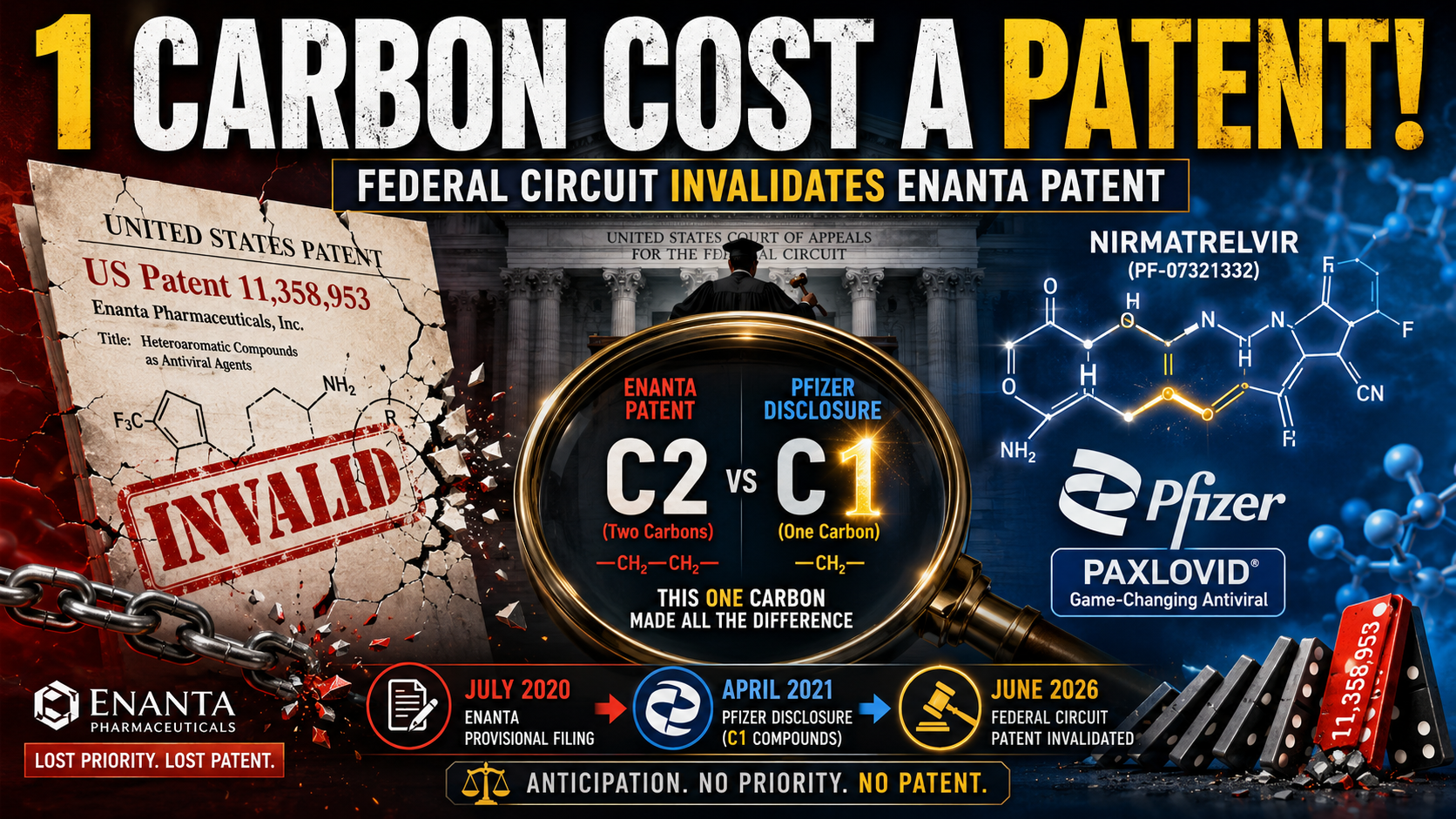
The U.S. Court of Appeals for the Federal Circuit has affirmed in favor of Pfizer, ruling that all asserted claims of Enanta Pharmaceuticals’ U.S. Patent No. 11,358,953 are invalid as anticipated. The June 23, 2026 decision marks a major development in the high-profile Pfizer patent litigation concerning Paxlovid. The court’s decision turns on a priority-date issue caused by a discrepancy between Enanta’s provisional application and the later-issued patent, which prevented Enanta from relying on its earlier filing date.
Enanta vs Pfizer Patent Dispute – Background:
Enanta Pharmaceuticals owns U.S. Patent No. 11,358,953, which claims compounds and methods for inhibiting coronavirus replication. The patent traces priority to Enanta’s provisional application filed on July 20, 2020, and the provisional and issued patent both define the term “substituted” and list numerous chemical compounds and moieties, with one key difference in a substituent definition.
The provisional application recited the substituent as “NHC(O)-C2-C12-alkyl,” while the issued patent recited “NHC(O)-C1-C12-alkyl.” That difference mattered because the C1 version includes a one-carbon alkyl group, which was relevant to the compound nirmatrelvir later disclosed by Pfizer.
Pfizer’s Prior Disclosure:
On April 6, 2021, Pfizer publicly disclosed nirmatrelvir, the protease inhibitor that later became part of Paxlovid. According to the Federal Circuit’s reasoning, nirmatrelvir fell within the scope of the claims only if Enanta could validly claim the benefit of the July 2020 provisional filing date.
Once that priority date failed, Pfizer’s public disclosure became intervening prior art and anticipated the asserted claims. The timing of that disclosure was therefore central to the invalidity ruling.
The Typographical Error Argument:
Enanta argued that the “C2” language in its provisional application was simply a typographical error and should have been understood as “C1.” Enanta maintained that the later correction did not add new matter and should not defeat priority.
However, the district court rejected that position, finding that the error was not the kind of obvious mistake the court could correct. The court concluded that changing “C2” to “C1” impermissibly broadened the disclosure and deprived the ’953 patent of the provisional’s priority date.
Federal Circuit’s Holding:
The Federal Circuit affirmed the district court’s ruling and agreed that the asserted claims were invalid. In doing so, the court held that Enanta could not rely on the provisional application to support the later-claimed one-carbon species, and Pfizer’s earlier public disclosure therefore anticipated the patent.
In practical terms, the court treated the issue as one of written-description support and priority, not merely a harmless clerical mistake. Because the provisional did not sufficiently disclose the claimed subject matter, Enanta lost the benefit of its earlier filing date.
Practical Takeaway:
This decision underscores the importance of carefully reviewing provisional applications for even minor structural or chemical wording differences. In pharmaceutical patent practice, a single carbon atom can determine whether a patent survives an anticipation challenge or falls away entirely.
It also shows that courts may be unwilling to rewrite a provisional disclosure after the fact, even where the applicant believes the error is obvious. For patent owners, that makes exact drafting and internal validation of chemical definitions critical at the filing stage.
Conclusion:
The Federal Circuit’s decision is a significant reminder that priority entitlement depends on what the provisional application actually discloses, not what the applicant later intended to disclose. Here, the difference between “C2” and “C1” proved decisive, and Pfizer’s intervening disclosure was enough to invalidate the asserted claims of U.S. Patent No. 11,358,953.