

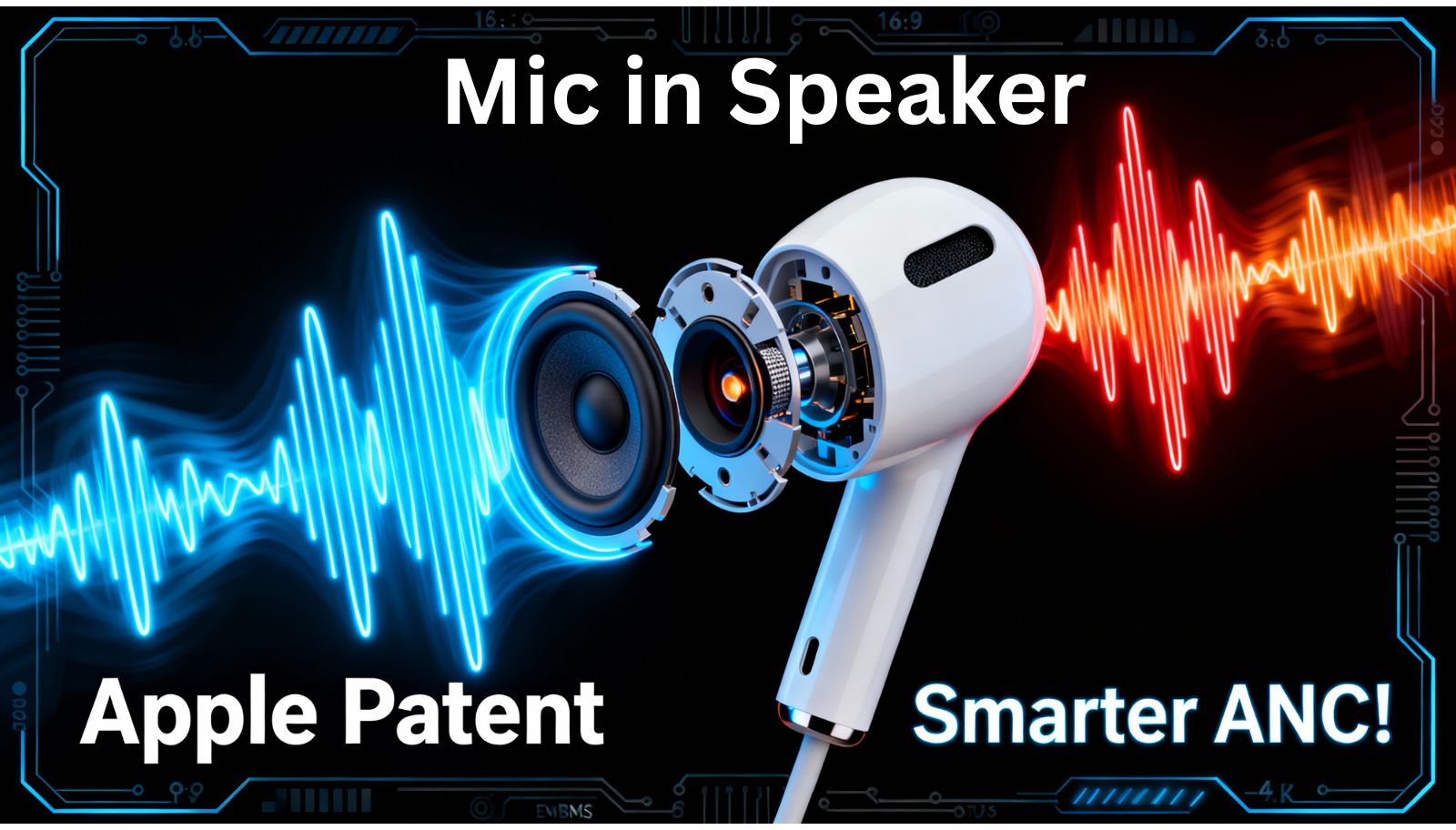
Apple Patent US12495234B2 for “Speaker and Microphone for Acoustic Devices” has been granted by the USPTO, detailing a compact method of placing a microphone inside the speaker’s front volume to enhance audio quality, active noise cancellation (ANC), and device assembly in products like earbuds, headphones, and other wearables.
Apple Patent – What this patent covers?
- Title: Speaker and Microphone for Acoustic Devices
- Patent Number: US12495234B2
- Assignee: Apple Inc
- Grant Date: Dec. 9, 2025
- Filing Date: May 8, 2023
Apple Patent – Core idea:
Mount a microphone so its sound-sensitive element sits in the speaker’s front volume (near the ear), while its electrical contacts route to a sealed rear/interior volume enabling accurate in-ear sound sensing without compromising acoustic sealing.
Apple Patent – Why this matter?
Putting a feedback or error microphone directly in the speaker’s front volume gives the device a truer measurement of what the listener actually hears, which is crucial for real‑time ANC tuning and clearer audio reproduction. This can reduce residual noise, improve anti-noise precision, and enhance music and voice playback in tight spaces like earbuds.
Apple Patent – Key technical details:
- Mic inside the front volume: The microphone’s diaphragm or MEMS element is placed in the space where sound exits toward the ear, enabling accurate sensing of pressure changes at or near the ear canal.
- Sealed electrical routing: While the mic listens in the front volume, its contacts are kept in a separate back or interior volume on the other side of the speaker frame, preserving airtight separation for acoustic performance.
- Multiple routing strategies:
- Flex-through-slit: A flexible printed circuit (FPC) holds the mic in front, passes through a slit in the speaker frame, and exposes contacts in the sealed rear volume; a sealant closes any remaining gap for airtightness.
- Laser direct-structured (LDS) traces: Conductive traces are patterned directly onto the speaker frame surface and can wrap around an edge to carry signals from front to back without bulky wiring.
- Molded pins and connectors: Contacts may be formed as molded pins on the rear side for robust connection to electronics, or the mic can be packaged with a board-to-board connector for quick assembly.
- Alternative mic mount: The microphone can be suspended above the diaphragm using a thin support structure so it sits between the driver and output port, still routing signals back to sealed electronics. The support avoids blocking sound and can be tuned to keep its resonances out of the audible band.
- Compact integration: The design allows both speaker and front-volume microphone to be pre-integrated as a single module, simplifying assembly into small products like earbuds, headphones, and other portable devices.
- Device targets: Examples include smartphones, earbuds, headphones, smart bands, smartwatches, and other audio-capable wearables or peripherals.
Apple Patent – How Apple implements it?
- Speaker frame as the backbone: The frame separates the front (toward the ear) from the back/internal volume and hosts mic mounts, routing slits, LDS traces, or molded contacts to keep the acoustics sealed while connecting the mic to system electronics.
- Mic options:
- MEMS microphone module attached to a small PCB, with a connector on the opposite side; the package can be insert-molded or sealed into an opening in the frame.
- Module with connector attached directly to the mic package, reducing parts and depth.
- Sealing strategy: Routing openings are carefully sealed (e.g., with anisotropic conductive adhesive or other sealants) so air cannot leak between the front and back volumes, preserving bass response and ANC performance.
- Shared flex harness: The same flex can carry both speaker drive and mic signals, simplifying wiring in tight industrial designs.
Apple Patent – Benefits for users:
- Better ANC and quieter commutes: Front-volume sensing improves the accuracy of anti-noise signals by measuring exactly what reaches your ear, helping cut low-frequency rumble and unpredictable ambient sounds more effectively.
- Clearer calls and media: By capturing sound closer to the ear output, the system can tune playback and feedback loops for clearer voices and more consistent tonal balance.
- Smaller, lighter designs: Integrating the mic into the speaker assembly reduces separate components and pathways, helping enable slimmer earbuds and more comfortable wearables.
- Reliability and durability: Molded contacts, sealed slits, and LDS traces reduce failure points and air leaks that can degrade sound over time.
Apple Patent – Real-world scenarios:
- Earbuds with adaptive ANC: The mic senses front-volume pressure changes in real time and feeds them to signal processing that adjusts anti-noise to current conditions on the street, in transit, or in an office.
- Headphones with improved transparency: Accurate in-cup sound measurement can help transparency modes blend external sounds more naturally without compromising bass or clarity.
- Wearables and small devices: Smart bands or compact speakers benefit from reduced wiring, sealed volumes, and integrated modules, making space for batteries or sensors without sacrificing audio performance.
Apple Patent – Design and manufacturing insights:
- Laser direct structuring (LDS): Enables conductive signal paths to be patterned directly onto a resin frame, ideal for tight geometries and curved routes over edges reducing bulky flex loops and simplifying sealing.
- Insert molding and modularity: By molding a mic package and connector into the frame, Apple can deliver a drop-in speaker-mic unit to final assembly, improving consistency and throughput.
- Sealing as a performance lever: The patent repeatedly emphasizes fluid sealing between front and back volumes; even tiny leaks can flatten bass and weaken ANC, so the mechanical routing choices are tightly coupled to acoustic goals.
Apple Patent – Where this could show up next:
Given the focus on compact assemblies and front-volume sensing, this approach is especially relevant to next-gen AirPods, over‑ear headphones, and other wearables where ANC, transparency, and call quality are key differentiators and where every cubic millimeter counts. The same module architecture can scale to smartphones, tablets, and peripherals that embed miniature speakers in constrained spaces.
Also Read Notable Inventions of Apple in Recent Time:
Apple Patent for Crash Detection
Apple Patent for Avatar Tech Based on Facial Feature Movement
Adaptive Apple Smart Watch Band Coming Soon?
Comfort and Hygiene liner Patent for Apple Vision Pro & other wearable
Apple’s Next Move? Is It Magnetically Attachable Gaming Accessory?
Apple Secures Patent for Innovative Battery Integration in Vision ProApple’s Next Big Vision Pro Upgrade Could Be in Your Ears?