


Hyundai’s influence in the compact SUV segment has only grown stronger over the years. Now, a new design patent published in India on Nov. 14, 2025, reveals a bold and futuristic exterior styling direction. With the next-gen Hyundai Venue already generating significant buzz through spy shots, teasers, and early design comparisons, enthusiasts are naturally curious: How closely does this newly published design patent align with the upcoming Venue?
Here below is a detailed, breakdown of the key visual elements and how they echo Hyundai’s broader design evolution.
Hyundai Next-Gen Venue vs Hyundai Design Patent – The patent details are as follows:
Basic Details of Newly Published Design
| Design Number | 470002-001 |
| Filing Date | Aug 18, 2025 |
| Journal Date | Nov 14, 2025 |
Image Source: Indian Patent Office’s Design and Patent Journal
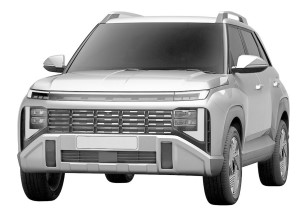
Hyundai Next-Gen Venue vs Hyundai Design Patent – Grille and Fascia
The newly published design patent features a wide, rectangular grille filled with multi-block geometric inserts, a design language consistent with Hyundai’s parametric styling seen in SUVs like the Creta and Palisade.
Meanwhile, the 2025 Hyundai Venue is moving away from its signature mesh grille toward a chunkier, horizontal-slat structure a clear effort to achieve a more premium, confident stance.
Hyundai Next-Gen Venue vs Hyundai Design Patent – What’s common?
- Strong geometric patterns
- Broad upright grille footprint
- Emphasis on bold, parametric shapes
Hyundai Next-Gen Venue vs Hyundai Design Patent – Headlamp & DRL Arrangement:
The newly patent showcases a split lighting setup:
- Slim, horizontal DRLs near the hood
- Vertically stacked main headlamps housed in a boxy enclosure
The next-gen Venue follows a similar hierarchy, adopting:
- Quad-LED headlamps
- Connected DRLs wrapping into C or L shaped LED signatures
Hyundai’s trend of separating DRLs and primary beams continues here, mirroring their newer SUV families.
Hyundai Next-Gen Venue vs Hyundai Design Patent – Front Bumper & Skid Plate: Tougher, Sharper, More SUV
Hyundai’s newly patent drawing highlights:
- Blocky bumper contours
- Deep air inlets
- A large, rectangular silver skid plate
The Venue’s 2025 redesign mirrors this with:
- A sculpted, more muscular bumper
- Larger faux skid plate
- Vertical corner elements and thick cladding
Both designs aim for a rugged SUV character, aligning with market demand in India and global segments.
Hyundai Next-Gen Venue vs Hyundai Design Patent – Body Sides, Wheel Arches & Roofline: The 2025 Angular Aesthetic:
Whether in the newly patent or the Venue spy shots, Hyundai is clearly leaning toward:
- Squared wheel arches
- Upright proportions
- Clean shoulder lines
- Silver roof rails
- Aerodynamic but upright window shapes
The boxier silhouette seen across Hyundai’s future SUVs is also reflected here, departing from the softer curves of previous generations.
Hyundai Next-Gen Venue vs Hyundai Design Patent – Rear Design: Patent Limitation vs Venue Evolution
The published design patent focuses primarily on the front, leaving the rear largely undefined.
In contrast, Venue prototypes reveal:
- A sleek LED light bar
- Reworked tailgate and bumper
- Fresh badging placement
- A more cohesive lighting signature
Remember, as always with design patents, the absence of utility elements (tailgate mechanics, boot design) is normal they protect appearance, not functional details.
Hyundai Next-Gen Venue vs Hyundai Design Patent – Modern Hyundai Design Touches: What the Patent & Venue Share
Across both the published patent disclosures and new Venue glimpses, we see Hyundai continuing to refine:
- Connected LED bars
- Square or vertically oriented lamp housings
- Geometric grille textures
- Large, sculpted bumper volumes
These elements reinforce Hyundai’s global SUV identity heading into 2025 and beyond.
Design patents protect only the appearance, not mechanical, engineering, or feature-related aspects. Any comparison here is visual not predictive of final production specs.
Hyundai Next-Gen Venue vs Hyundai Design Patent – Conclusion:
While there are notable overlaps between the newly published design patent and the upcoming Hyundai Venue, it’s essential to view both through the right lens one is a legal safeguard for design, the other is a near-production model undergoing market testing. The journey from patent to production includes countless refinements in engineering, materials, and user experience. What we do see, however, is a clear continuation of Hyundai’s bold, geometric, and future-ready SUV design language.
Disclaimer:
This blog post is intended solely for informational purposes. It is not an official communication from Hyundai or the Indian Patent Office, nor should it be interpreted as providing any conclusive findings or authoritative statements. The information discussed herein is derived from publicly available design publications. Readers are advised to consult official announcements, press releases, and verified communications from Hyundai for accurate and up-to-date details regarding the company’s forthcoming models, design filings, or product specifications.

































1 thought on “Is it Hyundai Next-Gen Venue’s Design Patent? Key Visual Comparisons Explained”