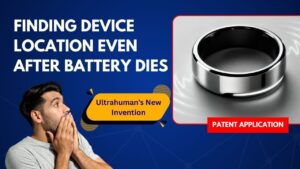


The ultrahuman smart ring is redefining the future of wearable technology with a breakthrough innovation that tackles one of the most persistent limitations of compact devices loss of tracking once the battery dies. As smart rings become smaller and smarter, traditional GPS or Bluetooth based tracking systems fail the moment power runs out. A newly published patent application – WO2025243327A1 from Ultrahuman introduces a transformative solution: a smart ring capable of broadcasting its location even with a completely drained battery. By combining ambient energy harvesting with an ultra-low-power communication module, Ultrahuman brings a new level of reliability and intelligence to next-generation wearables.
What problem this invention solves:
Ultrahuman smart ring innovation reflects a key challenge in modern wearables tiny devices like smart rings, earbuds, and fitness bands are difficult to track after their batteries die. Since GPS and Bluetooth trackers rely on power, they stop working the moment the battery drains. The technology disclosed in the newly published patent application – WO2025243327A on Nov 27, 2025, overcomes this limitation by enabling continuous location monitoring even with a completely discharged internal battery.
Ultrahuman Smart Rings Patent Application – Basic Details about company:
Ultrahuman has quickly emerged as one of the most forward-thinking brands in the global wearable technology space, known for blending advanced engineering with health-focused design. From continuous metabolic monitoring to next-generation smart rings, the company consistently pushes the boundaries of what compact wearables can achieve. This newly published patent application – WO2025243327A further reinforces Ultrahuman’s commitment to solving real-world challenges.
Ultrahuman Smart Rings Patent Application – Core idea: battery‑independent tracking:
The patent application discloses a wearable device integrates four key elements: sensors, an internal battery, a passive communication module, and an energy harvesting module working together as a system. When the internal battery is charged, the device behaves like a normal smart ring, measuring user biomarkers and communicating with nearby devices. When the battery is discharged, the energy harvesting module takes over and powers the passive communication module so the ring can still broadcast a signal containing its unique identifier (UID) and location-related data.
Ultrahuman Smart Rings Patent Application – How the smart ring works?
The wearable is preferably implemented as a smart ring made of hypoallergenic material for continuous, comfortable use while tracking health and activity data. Once the ring is misplaced and its internal battery is depleted, the tracking mode is triggered and the device starts relying on harvested ambient energy instead of stored battery power. At predefined intervals, the ring broadcasts its UID (and in some cases location data) so that nearby devices can detect and help locate it.
Ultrahuman Smart Rings Patent Application – Energy harvesting: turning ambient energy into power
A dedicated energy harvesting module is embedded in the ring to capture and convert ambient energy sources into electrical power. The module can harvest energy from radio frequency signals (for example from Wi‑Fi routers, cellular towers, or Bluetooth devices), thermal gradients (such as body heat), light (using miniature solar cells), and other technologies like piezoelectric or kinetic elements. This harvested energy is sufficient to keep the low‑power passive communication module alive so it can periodically transmit the UID even when the internal battery is completely discharged.
Ultrahuman Smart Rings Patent Application – Role of the passive communication module:
The passive communication module is a low‑energy wireless unit that broadcasts the ring’s UID and, where applicable, location information. It can operate using protocols such as Bluetooth Low Energy (BLE), Wi‑Fi, or other radio technologies, and is designed to work on very little power supplied by the energy harvesting module. The UID uniquely identifies the ring within the tracking network, enabling secondary devices and servers to distinguish it from other wearables.
Ultrahuman Smart Rings Patent Application – Network of secondary and primary devices:
The system uses an ecosystem of “secondary devices” such as smartphones, smartwatches, laptops, tablets, or PCs, which are located near the smart ring. These devices periodically scan for the UID broadcast by the ring, measure signal strength (for example using RSSI), and estimate its approximate location. The secondary devices then send the UID and computed location to either a server or a “primary device” associated with the user.
Ultrahuman Smart Rings Patent Application – Server and app‑based location visualization:
A server can collect UID and location data from multiple secondary devices, process them using location estimation algorithms, and derive a more accurate position for the smart ring. The user’s primary device (typically a smartphone or tablet) includes communication, locating, and user interface modules to receive this processed data and render the ring’s real‑time location on a graphical interface. This allows the user to view, track, and recover the misplaced ring through a dedicated app or web interface, even if the ring itself has no usable battery charge.
Ultrahuman Smart Rings Patent Application – Method steps of the tracking process:
The patent application outlines a method that begins with harvesting ambient energy when the internal battery is discharged, using RF, thermal, or light sources as available. Once enough energy is captured, the device activates the passive communication module, which transmits a signal containing at least the UID (and optionally location data) to nearby devices. These proximate devices receive the signal, validate it, log metadata such as signal strength or timestamps, and can relay this information to a server or directly to the primary device for visualization.
Ultrahuman Smart Rings Patent Application – Technical advantages and use cases:
The key technical advantage is reliable tracking of a wearable device without depending on continuous battery charging or active GPS. By using ambient energy and low‑power communication, the system offers maintenance‑free, sustainable location tracking that integrates seamlessly with everyday smart devices. This makes it particularly attractive for premium smart rings and other compact wearables where battery volume is limited but loss risk and replacement cost are high.
Ultrahuman Smart Rings Patent Application – Conclusion:
The Ultrahuman smart ring patent application demonstrates a major leap forward in wearable tracking technology. By integrating ambient energy harvesting with ultra-low-power communication modules, the system ensures that the ring remains trackable even after its battery is fully discharged. This innovation eliminates one of the biggest limitations of compact wearables loss of tracking after power depletion. With sustainable, battery-independent location monitoring and seamless integration with nearby devices, this technology significantly enhances user convenience, device security, and the overall reliability of smart wearables. As next-generation wearables continue to shrink in size and grow in capability, such energy-efficient tracking systems represent a meaningful shift toward smarter, more resilient device ecosystems.
Disclaimer:
This post is based on information disclosed in a published patent application. A patent application represents a proposed concept and may not reflect final commercial features. The details summarized here are for informational and educational purposes only and should not be considered technical, legal, or professional advice.
Ultrahuman’s Next-Gen Wearables: Files Patent for Physiological Stress Monitoring System