
Wyeth v. AstraZeneca: Why the Federal Circuit Affirmed Invalidity of the EGFR Treatment Patents
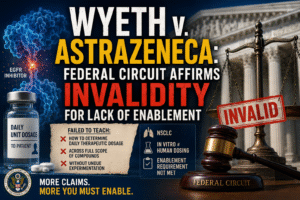
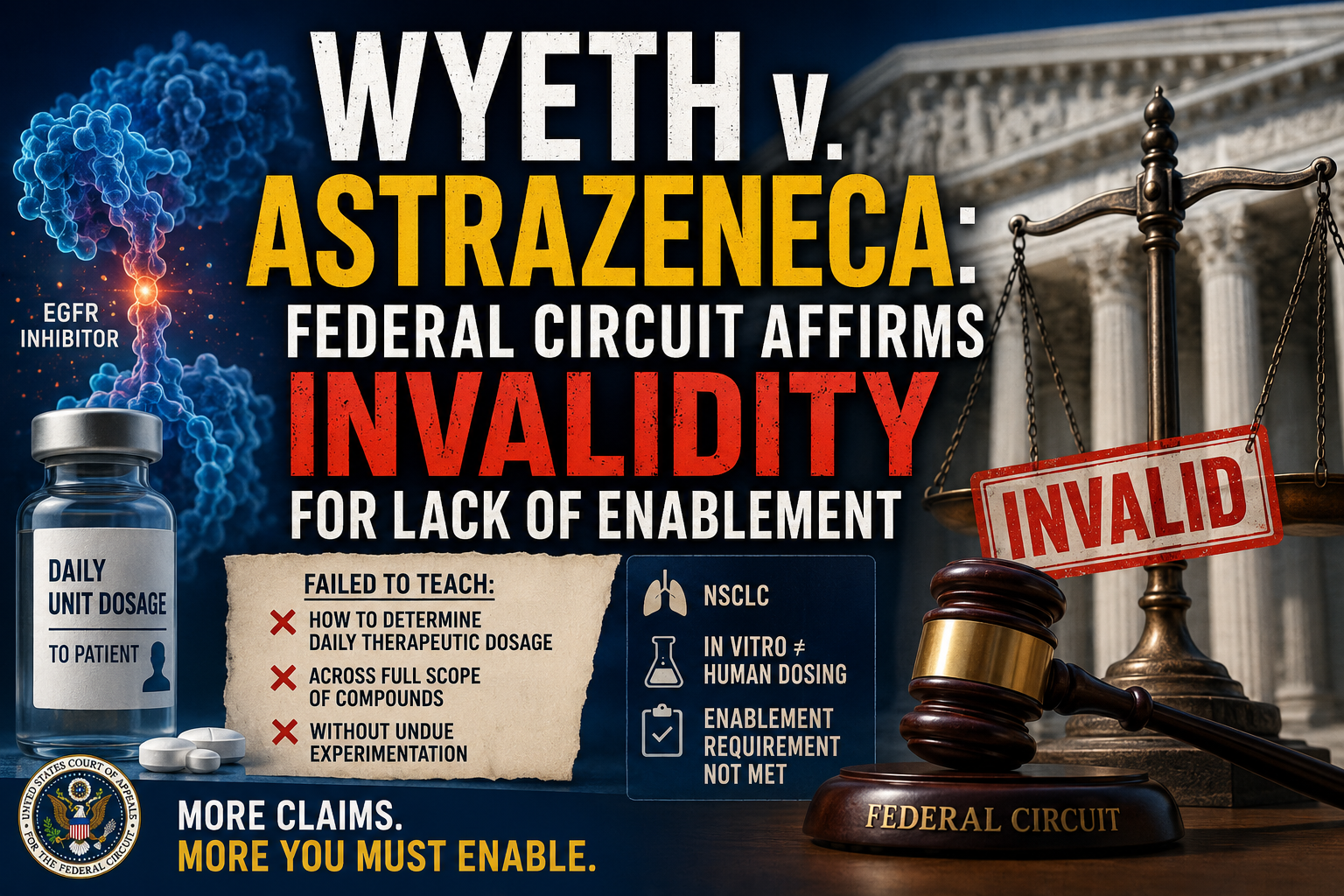
The Federal Circuit’s July 9, 2026 decision in Wyeth LLC v. AstraZeneca Pharmaceuticals LP is a strong reminder that a patent must enable the full scope of what it claims, not just an attractive scientific concept. In affirming JMOL of invalidity, the court held that Wyeth’s patents failed to teach how to determine a daily, patient-usable “unit dosage” of the claimed irreversible EGFR inhibitors without undue experimentation.
Wyeth v. AstraZeneca: Introduction
Pharmaceutical patent disputes often turn on a difficult balance: broad claims can be commercially valuable, but broad claims also face serious enablement risk when the patent specification does not provide enough technical detail. That balance was central here, where Wyeth asserted patents directed to treating gefitinib- and/or erlotinib-resistant NSCLC using irreversible EGFR inhibitors. AstraZeneca prevailed because the court found the patents did not teach a skilled artisan how to translate in vitro results into a daily therapeutic regimen for human patients across the full claim scope.
Wyeth v. AstraZeneca: Case Background
Wyeth sued AstraZeneca in the District of Delaware, accusing AstraZeneca’s Tagrisso product of inducing infringement of the asserted patents, U.S. Patent Nos. 10,603,314 and 10,596,162. A jury found the claims not invalid and awarded Wyeth $107.5 million in damages, but the district court later granted AstraZeneca’s renewed JMOL motion and held the asserted claims invalid for lack of enablement under 35 U.S.C. § 112(a). The Federal Circuit affirmed that ruling in full.
The patents generally concerned methods of treating NSCLC using irreversible EGFR inhibitors that covalently bind specific cysteine residues in EGFR or erb-B2. The asserted claims required administering a “unit dosage” daily to a patient, and the specification defined “unit dosage” as a physically discrete dose containing a predetermined amount of active material calculated to produce the desired therapeutic effect. That claim language became the center of the enablement dispute.
Wyeth v. AstraZeneca: Why the Claims Failed
The Federal Circuit agreed that the claims did not impose FDA style clinical safety or efficacy requirements, but it also held that the claims were not as minimal as Wyeth suggested. The court explained that the language requiring daily administration of a “unit dosage” to a patient necessarily required a dosage regimen that could actually produce a therapeutic effect in humans. In other words, the claims were not limited to compounds that merely looked active in vitro.
The problem was that the specification did not teach how to determine that daily therapeutic dosage across the full scope of the claimed compounds. It offered only three example compounds, no working examples of human dosing, and only broad, “general” and “projected” dosage ranges without explaining how those ranges were derived or how a skilled artisan should select a dose for a particular compound. The court viewed that as leaving the critical dosing determination to the knowledge and experimentation of the artisan rather than supplying the invention’s missing teaching.
Wyeth v. AstraZeneca: Enablement Analysis
Enablement requires the patent specification to teach a person of ordinary skill how to make and use the full scope of the claimed invention without undue experimentation. The Federal Circuit relied on modern enablement principles, including Amgen v. Sanofi, to emphasize that the more one claims, the more one must enable. Because Wyeth’s claims covered a functionally defined class of irreversible EGFR inhibitors administered daily as a therapeutic unit dosage, the court expected real guidance on how to arrive at usable human dosing.
The evidence at trial strongly supported AstraZeneca’s position. Wyeth’s own experts acknowledged that therapeutic doses must avoid toxicity, and testimony showed that the patent’s disclosed dosage ranges exceeded the maximum tolerated dose for at least two disclosed compounds and possibly a third. The inventors themselves had also recognized in later work that in vitro concentrations might not be achievable in patients because of drug toxicity. That evidence made the claims look less like a fully enabled treatment method and more like a starting point for further research.
Wyeth v. AstraZeneca: Claim Construction Lesson
Wyeth argued that the district court improperly imported toxicity, safety, and efficacy limitations into the claims after trial. The Federal Circuit rejected that argument, explaining that the district court did not add a new requirement; instead, it gave effect to the already-construed language of “unit dosage” and “administering daily to the patient”. The court also said the post-verdict explanation merely clarified what was inherent in the original construction.
That distinction matters for patent drafting and litigation strategy. A claim term can sound broad on its face, but if the specification defines it in patient-centered, functionally meaningful terms, the patent may still need enough disclosure to support practical human use. Here, the court found that daily therapeutic administration in a patient could not be reduced to mere cell-killing data or an abstract concentration range.
Wyeth v. AstraZeneca: Practice Takeaways
For pharma patent drafters, the case is a warning against relying too heavily on broad therapeutic language without concrete dosing guidance. If the claim is going to cover patient treatment, the specification should ideally explain how to translate biological activity into clinically relevant dosing, especially where the chemistry or pharmacology is unpredictable. Working examples, dose-finding logic, or clear selection criteria can be critical when the claim covers a wide functional genus. For litigators, the case also shows how enablement challenges can succeed even after a jury verdict. Evidence that some disclosed embodiments are inoperative can be powerful when the claims demand patient-administered treatment but the patent lacks a reliable path from lab data to human dosing. In a crowded and complex field, a patent cannot simply ask the artisan to figure it out through trial and error.